
Wisdom Teeth: Diagnosis
9 Out of 10 People Have at Least One Impacted Wisdom Tooth
Did you know that approximately 9 out of 10 people develop at least one impacted wisdom tooth? Impacted wisdom teeth are the most common reason third molars need to be removed. While some wisdom teeth erupt normally, many become trapped beneath the gums or jawbone because there simply isn’t enough room for them to grow into the proper position.
32 Teeth, But Only Room for 28
Most adults develop 32 permanent teeth, including four wisdom teeth. However, the average jaw comfortably accommodates only 28 teeth. Because wisdom teeth are the last permanent teeth to develop—typically between the ages of 17 and 25—they often don’t have enough space to erupt properly.
During your wisdom teeth evaluation, our oral surgeons use a comprehensive examination and digital X-rays to determine whether your wisdom teeth have enough room to erupt or if they are likely to become impacted. Early diagnosis allows us to identify potential problems before they lead to pain, infection, or damage to nearby teeth.
What Does It Mean If a Wisdom Tooth Is Impacted?
An impacted wisdom tooth is one that cannot fully erupt because it is blocked by another tooth, gum tissue, or the surrounding jawbone. Instead of growing straight into place, impacted wisdom teeth may develop at an angle, grow sideways or backward, or remain completely beneath the surface of the gums.
Many impacted wisdom teeth don’t cause immediate symptoms, but they can increase your risk of developing serious oral health problems over time. Depending on their position, impacted wisdom teeth may contribute to:
- Pain, pressure, or swelling in the back of the mouth
- Infections around partially erupted teeth
- Damage to neighboring molars
- Tooth decay or gum disease in hard-to-clean areas
- Cysts that develop around impacted teeth
- Crowding or changes to your bite in some patients
For these reasons, Dr. Romanow, Dr. Perez, Dr. Niloy or Dr. Peters
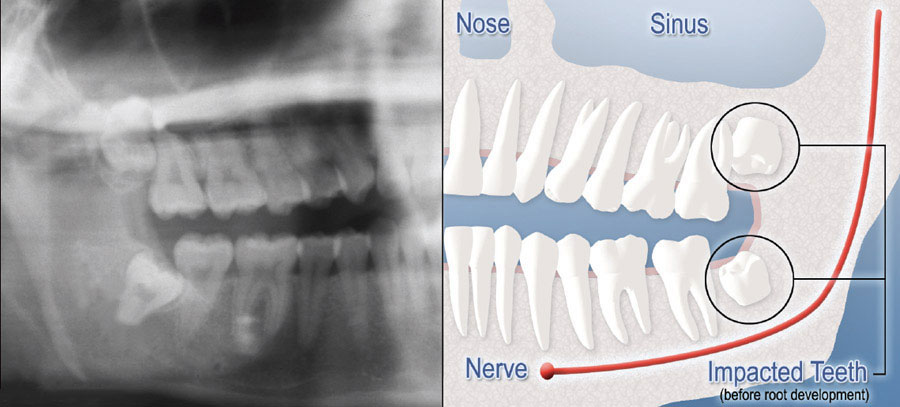
Classification of Wisdom Tooth Impaction: Terms to Know
Not all impacted wisdom teeth are the same. During your consultation, your oral surgeon will evaluate the position of your wisdom teeth and classify the impaction based on both the angle of the tooth and how much of it remains beneath the gums or jawbone. Understanding these classifications helps determine the most appropriate treatment approach.
Angulation
- Mesial Impaction: The most common type of impaction. The wisdom tooth is angled toward the front of the mouth and presses against the neighboring tooth.
- Horizontal Impaction: The tooth is positioned on its side, lying horizontally within the jawbone.
- Distal Impaction: The tooth is angled toward the back of the mouth.
- Vertical Impaction: The tooth is mostly upright but is unable to fully erupt because there isn’t enough available space.
Tissue Type
- Soft Tissue Impaction: The crown of the tooth has emerged through the jawbone but remains covered by gum tissue.
- Partial Bony Impaction: Part of the tooth has erupted, but a significant portion remains trapped within the jawbone.
- Complete Bony Impaction: The entire wisdom tooth remains completely enclosed within the jawbone.
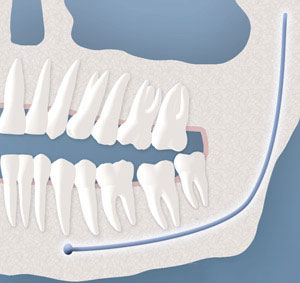 Soft Tissue
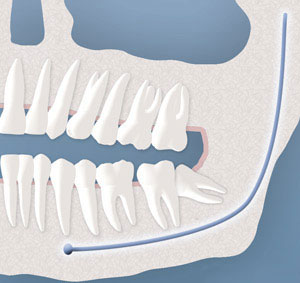 Partial Bony
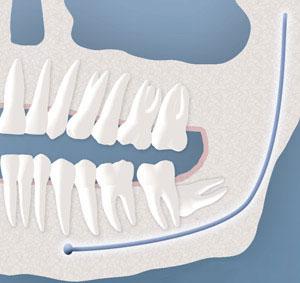 Complete Bony
When Should Wisdom Teeth Be Evaluated?
Even if your wisdom teeth aren’t causing pain, regular evaluations are important. Many impacted teeth develop silently, and early diagnosis often allows for simpler treatment and a smoother recovery. Our oral surgeons commonly recommend a wisdom teeth evaluation during the late teenage years or early twenties, when the roots are still developing and removal is often easier.
If you’ve been told you have one or more impacted wisdom teeth, you’re certainly not alone. This is one of the most common conditions we treat. Our experienced oral surgeons perform wisdom teeth evaluations and extractions every day and are equipped to manage everything from straightforward cases to the most complex impactions. If you have questions about your wisdom teeth or would like to schedule a consultation, our team is here to help.